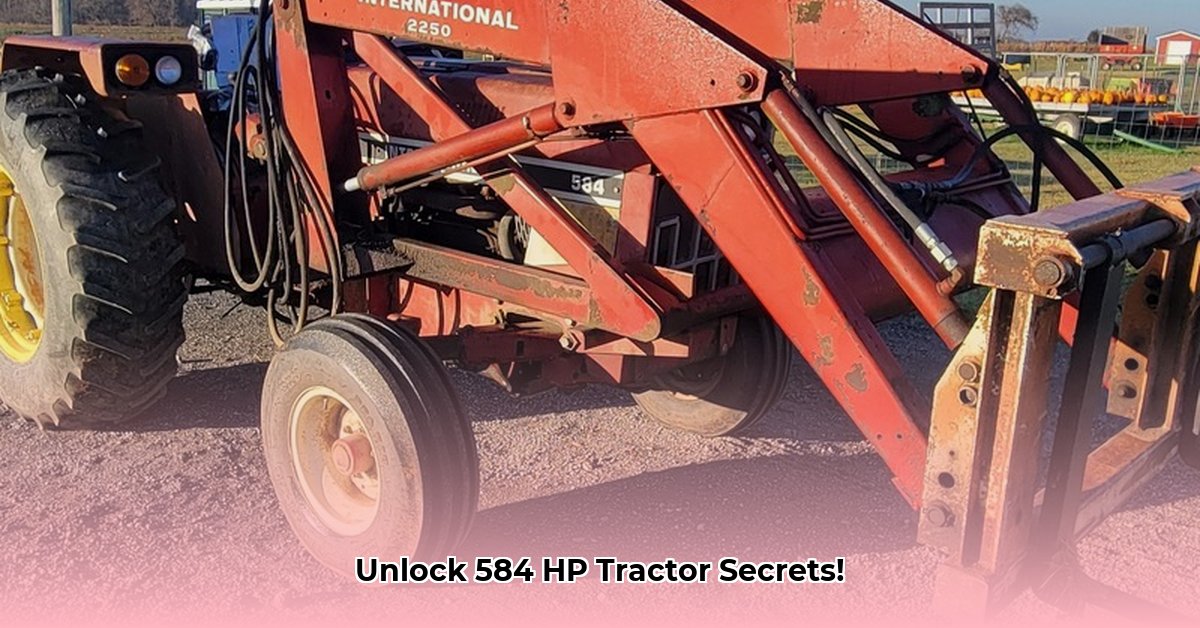
The International Harvester 584, a stalwart of the late 1970s and early 1980s, represents more than just agricultural machinery; it embodies a fascinating case study in sustainable farming practices, particularly when viewed through a historical lens. This article explores its legacy, examining its operational efficiency, surprisingly relevant sustainability aspects, and practical guidance for maintenance and restoration. For detailed horsepower specifications, check out this helpful resource: Tractor Specs.
The 584: A Powerful Workhorse of Yesteryear
Imagine the rolling fields, the aroma of freshly tilled soil, and the powerful rumble of an International Harvester 584 traversing the landscape. Produced between 1977 and 1984, the 584 was built to endure. Its approximately 60.8 horsepower diesel engine 1 could effortlessly handle demanding agricultural tasks. But how does this vintage machine relate to modern sustainable farming principles? This is a question which warrants deeper investigation.
Power vs. Efficiency: Contextualizing Sustainability
While undeniably powerful, the 584's fuel efficiency wouldn't meet today's stringent standards. Think of it as a classic muscle car—impressive power, but with considerable fuel consumption. However, the context of its era is crucial. Environmental regulations were far less stringent then, and fuel costs were significantly lower. Therefore, judging its "sustainability" solely by modern metrics is misleading. It's more accurate to assess it within the parameters of its time.
Durability: A Cornerstone of Sustainable Design
The tractor's remarkable durability is a key aspect of its sustainability. Many 584s remain operational today, demonstrating a robust design. This longevity signifies reduced resource consumption—a "build-to-last" philosophy less common in modern machinery. Its relatively straightforward mechanical design simplifies repairs, extending its lifespan and minimizing waste. This contrasts with many modern tractors, which often have shorter lifespans and far more complex (and costly) repair needs.
Sustainability Re-examined: Multiple Perspectives
Let's analyze the 584's sustainability from several perspectives:
Extended Lifespan and Reduced Resource Consumption: The tractor's prolonged operational life means fewer replacements are needed, lowering material consumption and manufacturing-related carbon footprints.
Repairability and the Circular Economy: Its straightforward design promotes repairability, reducing reliance on costly replacements. This aligns perfectly with the circular economy model, maximizing the product's life cycle and minimizing waste.
Fuel Consumption and Lifecycle Assessment: Quantifying the 584's fuel consumption across its entire lifespan proves challenging due to a scarcity of comprehensive data. A detailed lifecycle assessment (LCA), encompassing manufacturing, usage, and disposal, is crucial for a complete understanding of its environmental impact and comparison with modern counterparts.
Comparing the 584 to Modern Tractors
Direct comparisons to modern tractors are difficult without complete lifecycle data on the 584's fuel usage. However, its repairability and longevity remain significant advantages. Modern tractors, despite advanced technology, are often complex, leading to higher repair costs and shorter lifespans. This results in higher disposal rates, thus increasing their overall environmental impact.
The 584's Legacy: A Call for Re-evaluation
The International Harvester 584 powerfully illustrates the contribution of durable, repairable machinery to sustainable agriculture. Its continued presence in fields worldwide challenges our current consumption patterns. What if we prioritized durability and repairability in agricultural equipment, even at the cost of some advanced features? The 584’s success suggests this is a question deserving serious consideration.
Future Directions: Learning from the Past
The 584's story transcends a mere evaluation of vintage machinery; it prompts introspection on our relationship with technology and its environmental impact. It highlights the importance of considering the entire lifecycle of agricultural equipment, encompassing manufacturing, operation, and disposal. Continued research is needed to understand fully the impact of both vintage and modern equipment on sustainable farming practices. This includes exploring ways that design choices and materials can better contribute to circular economy principles.
How to Calculate the Lifecycle Cost of a Vintage IH 584 Tractor
Three Pivotal Points:
- The IH 584's lifecycle cost goes beyond the initial purchase price, including maintenance, repairs, fuel, and disposal.
- Accurate calculations are difficult due to limited readily-available historical data on operational costs.
- A well-maintained IH 584, due to its robust design and parts availability, can have a surprisingly low lifecycle cost compared to modern, technology-laden tractors.
Calculating the precise lifecycle cost of a vintage IH 584 requires a structured approach:
Initial Purchase Price: Determine the current market value based on condition and hours of operation using online resources.
Maintenance & Repair: Estimate routine maintenance costs and budget for potential major repairs, consulting mechanics or online IH communities for guidance.
Parts Availability: Assess the accessibility of replacement parts, accounting for potential delays and higher costs for less common items.
Fuel Consumption: Estimate fuel usage based on typical workload and fuel efficiency data (though this may be challenging to find).
Insurance & Storage: Factor in insurance premiums and storage costs as applicable.
Disposal Costs: Calculate scrap value or recycling costs for the tractor's eventual disposal.
This structured approach permits a reasonable approximation, recognizing that unexpected repairs are always a possibility. Remember: meticulous record-keeping of expenses throughout the tractor's operational life will provide the most accurate lifecycle cost assessment.